Background
Definitions
A matroid is a combinatorial structure that abstracts the notion of linear independence. More formally, a matroid \( M \) on a finite ground set \( E \) with independent sets \( \mathcal{I} \subseteq 2^E \) is a pair \( M = (E,\mathcal{I} \) satisfying the following properties:
- \( \emptyset \in \mathcal{I} \).
- If \( J \subseteq I \) and \( I \in \mathcal{I} \), then \( J \in \mathcal{I} \).
- If \( I,J \in \mathcal{I} \) and \( \lvert I \rvert > \lvert J \rvert \), then there exists an element \( e \in I \setminus J \) such that \( J \cup \{ e \} \in \mathcal{I} \).
- Elements of \( \mathcal{I} \) are called independent sets; maximal ones are called bases.
- Sets not in \( \mathcal{I} \) are called dependent sets; minimal ones are called circuits.
- The rank of a set \( F \subseteq E \) is the cardinality of a maximal indpendent set in \( F \), and is denoted \( \text{rk}(A) \). The closure of \( F \) is the set \[ \overline{F} = \{ e \in E \, \mid \, \text{rk}(F \cup \{ e \}) = \text{rk}(F) \}. \] If \( F \) satisfies \( \overline{F} = F \), then it is called a flat of \( M \).
- A matroid \( M \) is called simple if it has no \( 1 \)- or \( 2 \)-element circuits.
For a matroid \( M \), a remarkable fact is that the flats of \( M \) form a lattice \( \mathcal{L}(M) \), and if we further assume that \( M \) is simple, this lattice is a geometric lattice. In fact, a lattice is geometric if and only if it is the lattice of flats of a matroid. So, when \( M \) is a simple matroid, its lattice of flats \( \mathcal{L}(M) \) comes equipped with a meaningful and natural rank function.
Example
Let \( \mathbb{F} = \text{GF}(2) \) and consider the set \( E \) of points in \( \mathbb{F}^3 \) given as the columns of the following matrix: \[ \begin{pmatrix} p_1 & \dots & p_7 \end{pmatrix} = \begin{pmatrix} 1 & 1 & 1 & 1 & 0 & 0 & 0 \\ 1 & 1 & 0 & 0 & 1 & 1 & 0 \\ 1 & 0 & 1 & 0 & 1 & 0 & 1 \end{pmatrix}. \] Here, the independent sets are given by subsets of \( E \) which are linearly independent. Thus, \( M = (E,\mathcal{I}) \) forms a matroid; this matroid is called the Fano plane or also the projective geometry of rank \( 2 \) of over \( \mathbb{F} \), denoted \( \text{PG}(2,2) \).
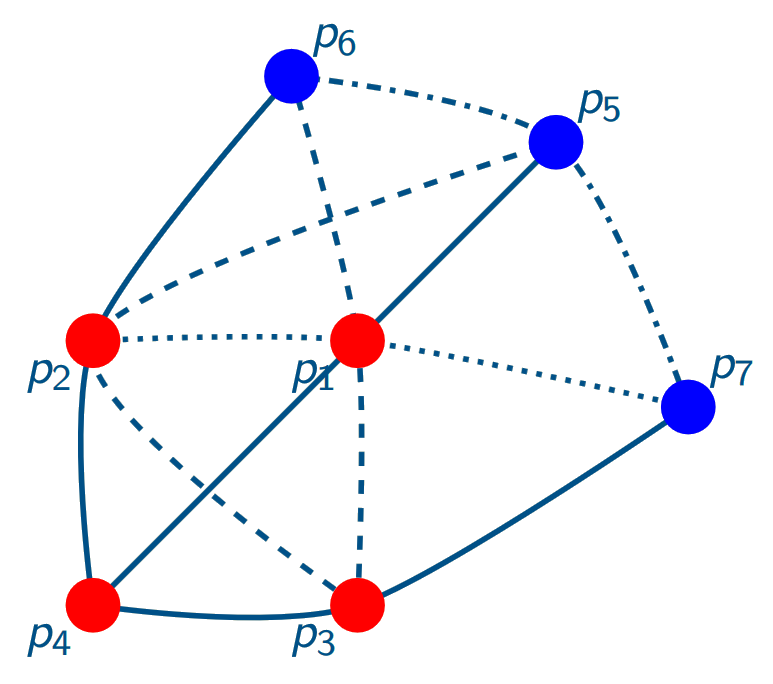
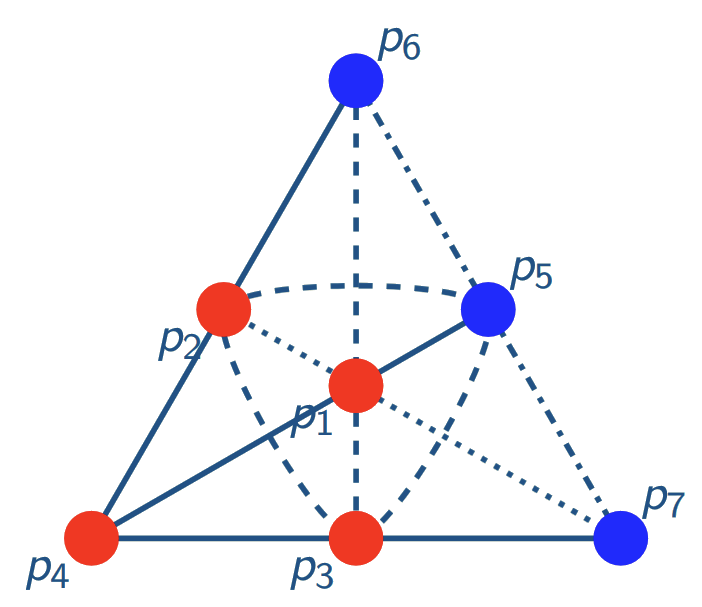
The Fano plane presented in two ways. Points in red lie on an affine patch whereas points in blue lie on the hyperplane at infinity.
In this setting, the closure corresponds to taking the span of a set of vectors. The lattice of flats is then
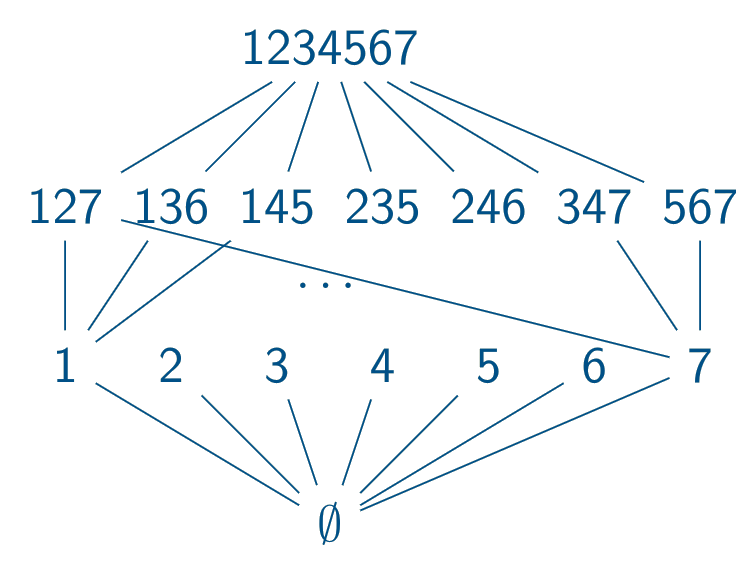
The rank function is given by the vector space dimension of the flat, so we can stratify the lattice by rank: \[ \begin{array}{|l||c|c|c|c|} \hline \text{rank} & 0 & 1 & 2 & 3 \\ \hline \# \mathcal{L}^i & 1 & 7 & 7 & 1 \\ \hline \end{array} \]
Results
Let \( M = (E,\mathcal{I}) \) be a simple matroid and let \( \mathbb{K} \) be a field of characteristic \( 0 \). The graded Möbius algebra of \( M \) is the standard graded \( \mathbb{K} \)-algebra \[ \textsf{B}_M = \bigoplus_{F \in \mathcal{L}(M)} \mathbb{K} x_F, \] with multiplication \[ x_F x_G = \begin{cases} x_{F \vee G} & \text{if } \text{rk}(F \vee G) = \text{rk}(F) + \text{rk}(G) \\ 0 & \text{otherwise} \end{cases}. \] A result of LaClair-Mastroeni-McCullough-Peeva shows that it has a presentation \[ \textsf{B}_M \cong \frac{\mathbb{K}[y_i \, \colon \, i \in E]}{(y_i^2 \, \colon \, i \in E) + (y_{C \setminus i} - y_{C \setminus j} \, \colon \, C \in \mathcal{C}(M))}. \] Proposition: Let \( M \) be a simple matroid with \( \textsf{B}_M \) its graded Möbius algebra. Then
- The Hilbert function of \( \textsf{B}_M \) is the rank-generating function of \( \mathcal{L}(M) \).
- The Castelnuovo-Mumford regularity of \( \textsf{B}_M \) is given by \( \text{reg} \, \textsf{B}_M = \text{rk} \, M = \text{rk} \, \mathcal{L}(M) \).
- The projective dimension of \( \textsf{B}_M \) is given by \( \text{pdim} \, \textsf{B}_M = \lvert E \rvert \).
Koszulness
Joint with Jason McCullough.In 2016, Maeno and Numata characterized which matroids have Gorenstein graded Möbius algebras. Using techniques from LaClair-Mastroeni-McCullough-Peeva, we show that these Gorenstein algebras are also Koszul. We also show that the graded Möbius algebras of affine geometries are quadratic.
Betti numbers [link]
Joint with Louiza Fouli, Selvi Kara, Adam LaClair, Jason McCullough, Vinh Nguyen, Aleksandra Sobieska, and Prajwal Udanshive.We compute explicit formulas for the graded Betti numbers of uniform matroids using techinques from liason theory.